
Daily Tips for Upright Posture: Simple Habits for a Stronger, Healthier You

Introduction
Take a moment right now to notice how you are sitting or standing. Are your shoulders rounded forward? Is your head jutting out toward your screen? Is your back slumped or curved? If you are like most people, there is a good chance your posture could use a little attention.
Good posture is something many of us take for granted until we start feeling the effects of neglecting it. The aches in our neck, the tension in our shoulders, the lower back pain that seems to come from nowhere. These are often signals from our body that something is out of alignment.
The truth is, posture is not just about looking confident and poised. It affects how we breathe, how we feel, and how our body functions overall. And while years of habits can be hard to undo, the good news is that small daily changes can make a big difference over time.
This article will share practical, easy-to-follow tips for improving your posture throughout the day. No special equipment required. Just simple awareness and gentle habits that can help you stand taller, sit better, and feel more comfortable in your own body.
What Is Good Posture?
Good posture means holding your body in a position that places the least strain on your muscles, joints, and ligaments. It is about alignment, keeping your body parts in their proper positions relative to each other.
When you have good posture, your body is balanced and efficient. Your muscles do not have to work as hard, and your joints are not under unnecessary stress. Everything flows more naturally.
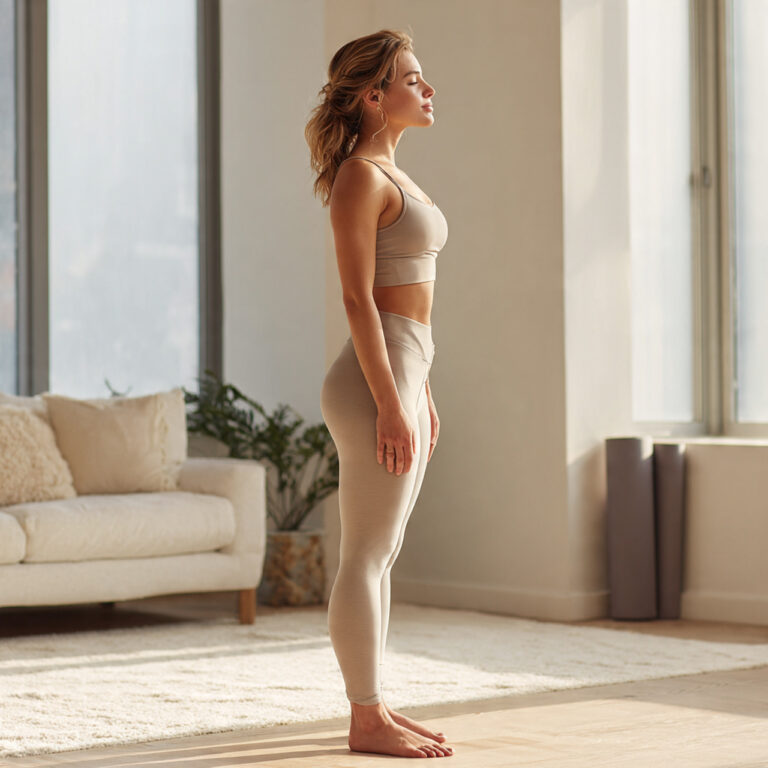
Standing posture: When standing with good posture, your ears, shoulders, hips, knees, and ankles should roughly align in a vertical line. Your chin is parallel to the floor, your shoulders are back but relaxed, and your weight is evenly distributed on both feet.
Sitting posture: When sitting with good posture, your feet are flat on the floor, your knees are at about a 90-degree angle, your back is supported, and your shoulders are relaxed. Your head is balanced over your spine, not pushed forward.
Dynamic posture: This refers to how you hold yourself while moving, whether walking, running, bending, or lifting. Good dynamic posture means moving efficiently with proper body mechanics.
Good posture is not rigid or stiff. It is relaxed, natural, and sustainable. It should feel comfortable once your body adjusts to it.
Why Posture Matters
You might wonder why posture deserves so much attention. Here are some reasons why maintaining good posture is important for your overall wellbeing:
Reduced muscle tension and pain: Poor posture puts extra strain on certain muscles, leading to tension, soreness, and pain, especially in the neck, shoulders, and back.
Better breathing: When you slouch, your lungs have less room to expand. Good posture opens up your chest and allows for deeper, fuller breaths.
Improved energy levels: When your body is aligned, it uses energy more efficiently. Poor posture can lead to fatigue because your muscles are working harder than they need to.
Enhanced confidence: Standing and sitting tall can positively affect how you feel about yourself and how others perceive you.
Better digestion: Slouching can compress your abdominal organs and interfere with digestion. Good posture supports healthy digestive function.
Reduced headaches: Tension in the neck and upper back from poor posture can contribute to tension headaches.
Joint health: Proper alignment reduces wear and tear on joint surfaces, which may help prevent discomfort over time.
Improved circulation: Good posture supports healthy blood flow throughout your body.
Taking care of your posture is an investment in your comfort, health, and quality of life.
Common Causes of Poor Posture
Understanding what contributes to poor posture can help you make changes. Here are some of the most common causes:
Prolonged sitting: Spending long hours sitting, especially at a desk or in front of a computer, is one of the biggest contributors to poor posture. Our bodies are not designed to sit for extended periods.
Phone and device use: Looking down at phones and tablets creates what is sometimes called “tech neck,” where the head juts forward and the shoulders round.
Weak core muscles: The muscles of your abdomen and back support your spine. When these muscles are weak, it is harder to maintain good posture.
Tight muscles: Tight chest muscles, hip flexors, and hamstrings can pull your body out of alignment and make good posture difficult.
Poor workspace setup: A desk, chair, or computer monitor at the wrong height can force you into awkward positions throughout the day.
Lack of awareness: Many people simply do not realize they have poor posture because it has become their normal.
Sedentary lifestyle: Without regular movement and exercise, muscles become weak and tight, making good posture harder to maintain.
Carrying heavy bags: Regularly carrying a heavy bag on one shoulder can create imbalances in your posture.
Stress and emotions: Stress, anxiety, and low mood can manifest in how we hold our bodies, often leading to slouching or hunching.
Unsupportive footwear: Shoes that do not support your feet properly can affect your entire posture from the ground up.
Sleeping positions: How you sleep and the quality of your mattress and pillow can influence your posture during waking hours.
Habit: Sometimes poor posture is simply a habit that has developed over years and feels normal even though it is not ideal.
Signs of Poor Posture
How do you know if your posture needs work? Here are some common signs:
- Rounded shoulders that curve forward
- Head that juts forward past your shoulders
- A hunched upper back, sometimes called kyphosis
- An exaggerated curve in the lower back
- Uneven shoulders or hips
- Neck pain or stiffness
- Upper back pain or tension between the shoulder blades
- Lower back pain or discomfort
- Frequent headaches, especially at the base of the skull
- Feeling tired or fatigued even without physical exertion
- Shallow breathing or feeling like you cannot take a full breath
- Jaw tension or pain
- Tight chest or shoulders
- Back pain that worsens throughout the day
- Difficulty standing up straight without effort
If you notice several of these signs, focusing on your posture could help you feel better.
Daily Tips for Better Posture
Now let us explore practical, everyday tips that can help you develop and maintain better posture. These are simple habits you can incorporate into your daily routine.
Check In With Yourself Regularly
One of the most powerful tools for better posture is simple awareness. Throughout the day, pause and notice how you are holding your body.
How to build posture awareness:
- Set reminders on your phone to check your posture every hour
- Use visual cues like sticky notes on your computer or mirror
- Every time you walk through a doorway, check your posture
- When you sit down, take a moment to adjust your position
- Notice how you feel when your posture is good versus poor
- Ask a friend or family member to gently remind you when they notice you slouching
- Take a quick body scan from head to toe several times a day
Awareness is the first step to change. The more you notice your posture, the easier it becomes to correct it.
Set Up Your Workspace Properly
If you spend time at a desk, how your workspace is arranged matters tremendously for your posture.
Workspace setup tips:
- Position your computer monitor at eye level so you do not have to look up or down
- Keep your screen about an arm’s length away from your face
- Use a chair that supports the natural curve of your lower back
- Adjust your chair height so your feet rest flat on the floor
- Keep your knees at about a 90-degree angle
- Position your keyboard and mouse so your elbows are close to your body and bent at about 90 degrees
- Avoid cradling your phone between your ear and shoulder
- If using a laptop, consider a separate keyboard and laptop stand
- Keep frequently used items within easy reach to avoid stretching or twisting
A well-organized workspace makes good posture much easier to maintain.
Take Movement Breaks
Sitting for long periods is hard on your posture, no matter how perfect your position. Regular movement breaks are essential.
Movement break ideas:
- Stand up and stretch every 30 to 60 minutes
- Take a short walk around your home or office
- Do a few gentle stretches at your desk
- Walk to get a glass of water
- Take phone calls standing or walking when possible
- Use a timer or app to remind you to move
- Do a lap around the building between tasks
- Stand while reading emails or documents
- Take the stairs instead of the elevator
- Walk to a colleague’s desk instead of sending an email
Even brief movement breaks can help reset your posture and relieve muscle tension.
Strengthen Your Core
A strong core provides the foundation for good posture. These muscles support your spine and help you maintain alignment throughout the day.
Simple core exercises:
Plank: Hold a push-up position with your body in a straight line. Start with 10 to 20 seconds and work up to a minute. Keep your core engaged and avoid letting your hips sag.
Bird dog: Start on your hands and knees. Extend your right arm forward and left leg back, keeping your back flat. Hold for a few seconds, then switch sides. Repeat 10 times on each side.
Dead bug: Lie on your back with arms extended toward the ceiling and knees bent at 90 degrees. Slowly lower your right arm and left leg toward the floor, then return to start. Alternate sides for 10 repetitions each.
Glute bridges: Lie on your back with knees bent and feet flat on the floor. Lift your hips toward the ceiling, squeezing your glutes at the top. Lower slowly and repeat 10 to 15 times.
Cat-cow stretch: On hands and knees, alternate between arching your back up like a cat and dropping your belly down while lifting your head. This warms up and mobilizes your spine.
Aim to do core exercises several times a week for best results.
Stretch Tight Muscles
Certain muscles tend to get tight from poor posture and can pull your body out of alignment. Regular stretching helps restore balance.
Helpful stretches for posture:
Chest stretch: Stand in a doorway with your arm bent at 90 degrees against the door frame. Gently lean forward until you feel a stretch in your chest. Hold for 30 seconds on each side.
Neck stretches: Gently tilt your head toward one shoulder, hold for 30 seconds, then switch sides. Also look up and down slowly, and turn your head side to side.
Upper back stretch: Clasp your hands in front of you and round your upper back, pushing your hands away from your body. Hold for 30 seconds.
Hip flexor stretch: Kneel on one knee with the other foot in front. Gently push your hips forward until you feel a stretch in the front of your hip. Hold for 30 seconds on each side.
Hamstring stretch: Sit on the floor with one leg extended. Reach toward your toes, keeping your back as straight as possible. Hold for 30 seconds on each side.
Child’s pose: Kneel on the floor, sit back on your heels, and reach your arms forward on the floor. Rest your forehead down and breathe deeply. Hold for 30 seconds to a minute.
Stretch gently and never force a position. Consistency matters more than intensity.
Practice Standing Tall
How you stand sets the tone for your posture. Practice standing with good alignment until it becomes second nature.
Tips for standing posture:
- Imagine a string pulling you up from the top of your head
- Keep your chin parallel to the floor, not jutting forward
- Roll your shoulders back and down, away from your ears
- Engage your core lightly, as if bracing for a gentle push
- Keep your knees soft, not locked
- Distribute your weight evenly on both feet
- Point your feet forward or slightly outward
- Tuck your pelvis slightly to avoid an exaggerated lower back curve
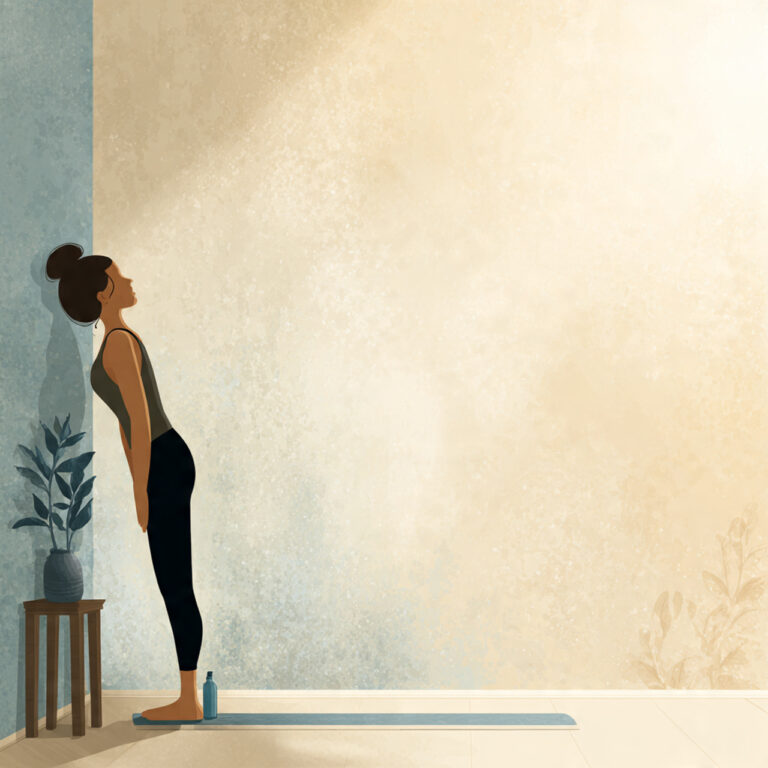
- Stand against a wall occasionally to check your alignment
Practice makes progress. The more you consciously stand tall, the more natural it becomes.
Sit With Intention
Since many of us spend significant time sitting, how we sit matters greatly for our posture.
Tips for sitting posture:
- Sit back in your chair so your back is supported
- Keep your feet flat on the floor or on a footrest
- Position your knees at about the same height as your hips or slightly lower
- Keep your shoulders relaxed, not hunched up toward your ears
- Avoid crossing your legs for extended periods
- Keep your chin level and head balanced over your spine
- Engage your core lightly to support your lower back
- Avoid slumping or leaning to one side
- Take breaks from sitting regularly
- Use a small pillow or rolled towel for extra lower back support if needed
Good sitting habits can prevent a lot of discomfort and tension.
Mind Your Phone Posture
Our phones are a major contributor to poor posture. Being mindful of how you use your devices can help.
Tips for better phone posture:
- Bring your phone up to eye level instead of looking down
- Take breaks from scrolling every few minutes
- Use voice-to-text features to reduce time spent looking down
- Hold your phone with both hands to keep your shoulders even
- Stretch your neck after phone use
- Be aware of how long you spend on your phone each day
- Consider using a tablet or computer for longer tasks
- When texting, keep your elbows close to your body
- Avoid using your phone while lying down in awkward positions
Small changes in how you use your phone can make a big difference for your neck and shoulders.
Sleep With Posture in Mind
The hours you spend sleeping affect your posture during waking hours. How you sleep matters.
Tips for sleep and posture:
- Choose a mattress that supports your spine without being too firm or too soft
- Use a pillow that keeps your head aligned with your spine
- If you sleep on your back, a pillow under your knees can help maintain your lower back curve
- If you sleep on your side, keep your spine straight and consider a pillow between your knees
- Avoid sleeping on your stomach, which can strain your neck and back
- Stretch gently before bed to release tension from the day
- Give yourself enough time for quality sleep each night
Waking up well-rested and without stiffness sets you up for better posture throughout the day.
Walk With Awareness
Walking is an opportunity to practice good posture in motion. Pay attention to how you carry yourself when you walk.
Tips for walking posture:
- Keep your head up and eyes looking forward, not down at the ground
- Relax your shoulders down and back
- Swing your arms naturally at your sides
- Engage your core lightly as you walk
- Take smooth, even steps
- Avoid leaning forward or backward
- Push off from your toes with each step
- Keep your chin parallel to the ground
- Walk as if you are balancing a book on your head
Walking with good posture not only feels better but also projects confidence.
Breathe Deeply
Deep breathing encourages good posture, and good posture makes deep breathing easier. They support each other.
How to practice deep breathing:
- Sit or stand with good posture
- Place one hand on your chest and one on your belly
- Breathe in slowly through your nose, letting your belly expand
- Your chest should move only slightly
- Exhale slowly through your mouth
- Repeat for several breaths
- Practice deep breathing several times throughout the day
Deep breathing also helps reduce stress, which can contribute to tension and poor posture.
Wear Supportive Footwear
Your feet are the foundation of your posture. What you put on them matters.
Tips for footwear and posture:
- Choose shoes with good arch support
- Avoid high heels for extended periods, as they shift your body’s alignment
- Replace worn-out shoes that no longer provide support
- Consider orthotic inserts if you need extra support
- Go barefoot at home when appropriate to strengthen foot muscles
- Choose flat, supportive shoes for everyday wear
- Make sure your shoes fit properly and are not too tight or too loose
Good footwear supports your whole body from the ground up.
Carry Bags Wisely
How you carry your bag can affect your posture significantly.
Tips for carrying bags:
- Use a backpack with two straps and wear both straps
- If using a shoulder bag, switch sides regularly
- Keep your bag as light as possible
- Choose bags with wide, padded straps
- Avoid carrying heavy bags on one shoulder for long periods
- Consider a rolling bag for heavy loads
- Distribute weight evenly in your bag
Balanced carrying helps prevent uneven stress on your body.
Practice Posture-Friendly Exercises
Certain exercises are particularly helpful for building the strength and flexibility needed for good posture.
Exercises that support posture:
Wall angels: Stand with your back against a wall, arms bent at 90 degrees. Slowly slide your arms up and down the wall, keeping your back and arms in contact with the wall.
Chin tucks: Sit or stand tall. Gently draw your chin back, creating a double chin, without tilting your head. Hold for a few seconds and release. Repeat 10 times.
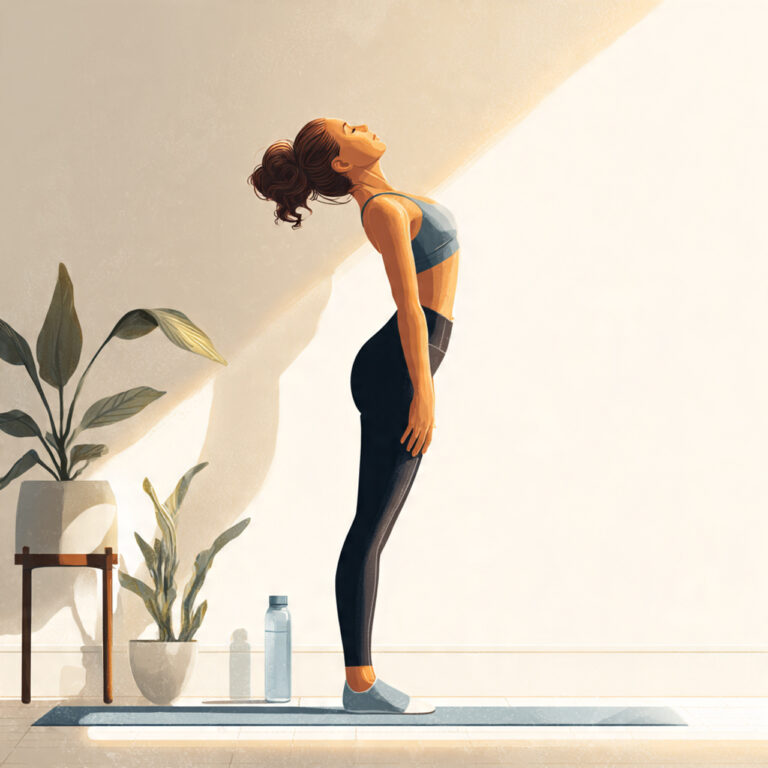
Thoracic extension: Sit in a chair and clasp your hands behind your head. Gently arch your upper back over the chair back, opening your chest. Hold briefly and return to start.
Shoulder blade squeezes: Sit or stand with arms at your sides. Squeeze your shoulder blades together as if holding a pencil between them. Hold for five seconds and release. Repeat 10 times.
Rows: Using a resistance band or light weights, pull your elbows back, squeezing your shoulder blades together. This strengthens the upper back muscles that support good posture.
Yoga and Pilates: Both practices emphasize body awareness, core strength, and flexibility, making them excellent for posture improvement.
Consistency with these exercises can lead to noticeable improvements over time.
Be Patient With Yourself
Changing posture habits takes time. Your body has likely adapted to certain positions over many years, and it takes time to create new patterns.
Tips for staying patient:
- Focus on progress, not perfection
- Celebrate small improvements
- Remember that some discomfort is normal as your body adjusts
- Do not expect overnight changes
- Be consistent with your efforts
- Forgive yourself when you catch yourself slouching
- Keep reminding yourself why better posture matters to you
- Take it one day at a time
Every moment of good posture is a step in the right direction.
What Helps and What to Avoid
Things That Help
- Regular posture check-ins throughout the day
- A properly set up workspace
- Frequent movement breaks
- Core strengthening exercises
- Regular stretching, especially chest and hip flexors
- Supportive footwear
- Sleeping on your back or side with proper support
- Bringing your phone to eye level
- Deep breathing practice
- Walking with awareness
- Yoga, Pilates, or other body-awareness practices
- Patience and consistency
Things to Avoid
- Sitting for long periods without breaks
- Looking down at your phone or devices for extended periods
- Slouching or slumping in your chair
- Carrying heavy bags on one shoulder
- Wearing high heels frequently
- Sleeping on your stomach
- Locking your knees when standing
- Ignoring pain or discomfort
- Expecting instant results
- Being too hard on yourself when you slip up
- A sedentary lifestyle without regular movement
- Poor workspace ergonomics
When to See a Professional
While daily habits can significantly improve posture for many people, there are times when professional guidance is helpful.
Consider seeing a healthcare provider if:
- You have persistent pain that does not improve with posture changes
- You notice significant asymmetry in your posture, like one shoulder much higher than the other
- You have difficulty standing or sitting upright even with effort
- You experience numbness, tingling, or weakness in your arms or legs
- Your posture has changed suddenly or dramatically
- You have a history of back injury or spinal conditions
- Pain interferes with your daily activities or sleep
- You want a personalized exercise or treatment plan
- You are unsure whether your posture issues require medical attention
Professionals who can help with posture include physical therapists, chiropractors, osteopaths, and physicians who specialize in musculoskeletal health.
Frequently Asked Questions
How long does it take to improve posture?
Improving posture is a gradual process. Some people notice improvements in how they feel within a few weeks of consistent effort. However, creating lasting change in posture habits typically takes several months of regular practice. Your muscles need time to strengthen, tight areas need time to become more flexible, and your brain needs time to form new habits. The key is consistency rather than intensity. Small daily efforts add up to significant changes over time.
Is it normal to feel sore when working on posture?
It is normal to experience some muscle soreness when you start working on your posture, especially if you are using muscles that have been weak or underused. This is similar to the soreness you might feel when starting a new exercise routine. However, sharp pain, severe discomfort, or pain that does not improve with rest is not normal and should be evaluated by a healthcare professional. Listen to your body and take it slowly.
Can posture really affect my mood and energy?
Yes, research suggests that posture can influence how we feel. Standing or sitting with good posture has been associated with increased energy, improved mood, and greater confidence. When you slouch, it can contribute to feelings of fatigue and even affect your outlook. While posture is not a cure for mood issues, maintaining good alignment is one of many factors that can support your overall wellbeing.
Should I use a posture corrector device?
Posture corrector devices, like braces or straps, can serve as helpful reminders to maintain good posture. However, they should not be relied upon as a long-term solution. The goal is to build the strength and habits to maintain good posture on your own. If you choose to use a posture corrector, use it as a training tool alongside strengthening exercises and awareness practice, not as a replacement for building your own postural strength.
Can children benefit from posture tips too?
Absolutely. Good posture habits are valuable at any age, and establishing them early can prevent problems later in life. Children today often spend significant time sitting, using devices, and carrying heavy backpacks, all of which can affect posture. Encouraging children to be aware of their posture, take movement breaks, and engage in physical activity supports their growing bodies. Making posture a family focus can help everyone develop healthier habits together.
Conclusion
Good posture is not about standing at attention like a soldier. It is about finding a balanced, comfortable alignment that supports your body and allows you to move through life with ease. It is about being kind to your body and giving it the care it needs to feel good.
The daily tips in this article are simple but powerful. Check in with yourself regularly. Set up your workspace thoughtfully. Take breaks to move and stretch. Strengthen your core and stretch tight muscles. Be mindful of how you use your phone, how you sleep, and how you carry yourself through the day.
Remember that change takes time. Your posture did not develop overnight, and it will not transform overnight either. But with patience, consistency, and gentle effort, you can make meaningful improvements that help you feel better in your body.
Stand tall, sit with intention, and move with awareness. Your body will thank you for it.
Disclaimer: This article is for informational purposes only and is not intended to diagnose, treat, cure, or prevent any medical condition. Always consult with a qualified healthcare professional before starting any new exercise routine or if you have concerns about your posture or musculoskeletal health.